
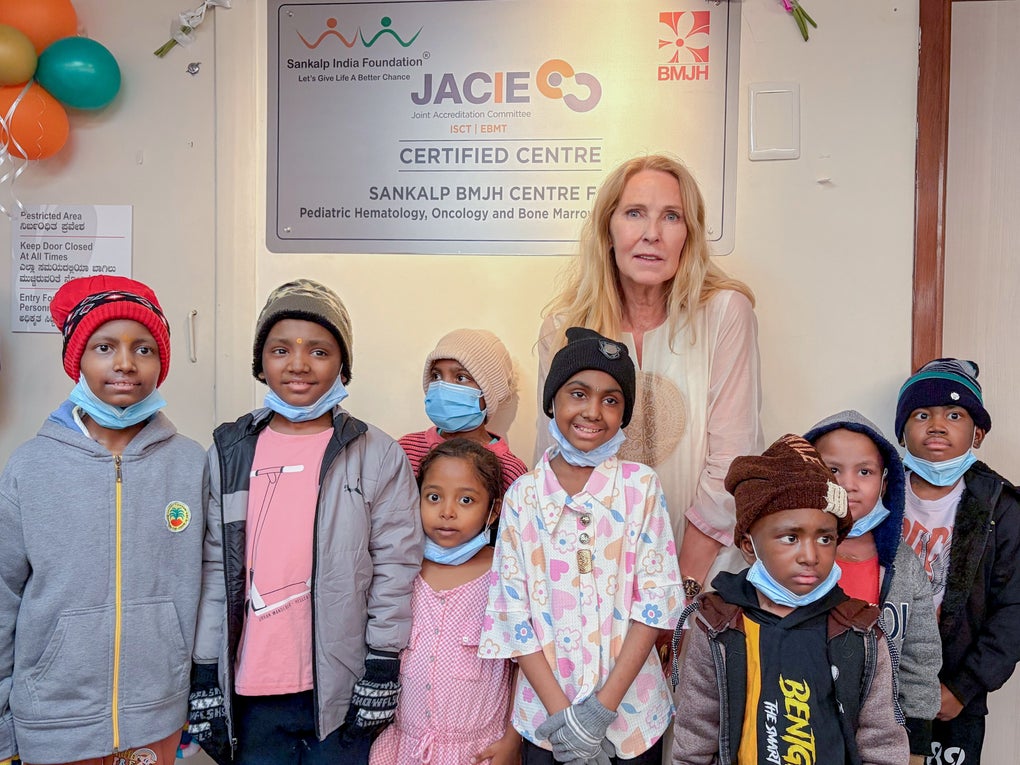
First JACIE accreditation in India for BMJH-Sankalp Centre
The Bone Marrow Transplant (BMT) Unit in Memory of Mechtild Harf at Bhagwan Mahaveer Jain Hospital was inaugurated in September 2021. DKMS funded the establishment of the unit to give more children with severe blood disorders, particularly thalassemia, access to potentially curative stem cell transplantation.
The center is operated by our long-standing partner Sankalp India Foundation, with medical support and expertise from Cure2Children. From the outset, the partnership has combined the expansion of treatment capacity with a strong focus on quality, expertise and sustainable local structures.
The new certification marks another important step in this development. JACIE, the accreditation body established by the European Society for Blood and Marrow Transplantation (EBMT) and the International Society for Cell & Gene Therapy (ISCT), provides a globally recognized benchmark for quality in hematopoietic stem cell transplantation and cellular therapy. Its standards cover the entire transplant program, including clinical care, stem cell collection and processing, quality management and patient safety.
Becoming the first JACIE-certified center in India demonstrates that internationally benchmarked quality and safety can go hand in hand with expanding access to treatment including in settings where resources are more constrained.
“As access has grown, so has quality. The recent JACIE certification of the BMJH-Sankalp program is an achievement worth celebrating. It is an important recognition of the quality structures and expertise that have been built alongside the growing number of children receiving treatment,” says Dr. Elke Neujahr, Global CEO of DKMS.


For DKMS, the achievement also reflects a central principle of our work to improve access to treatment: increasing the number of patients who can receive a potentially lifesaving transplantion must go hand in hand with strengthening local expertise and high standards of care. Our collaboration with Sankalp and Cure2Children in India is an important example of how long-term partnerships can help build sustainable transplantation capacity for patients who might otherwise have limited access to curative treatment.