
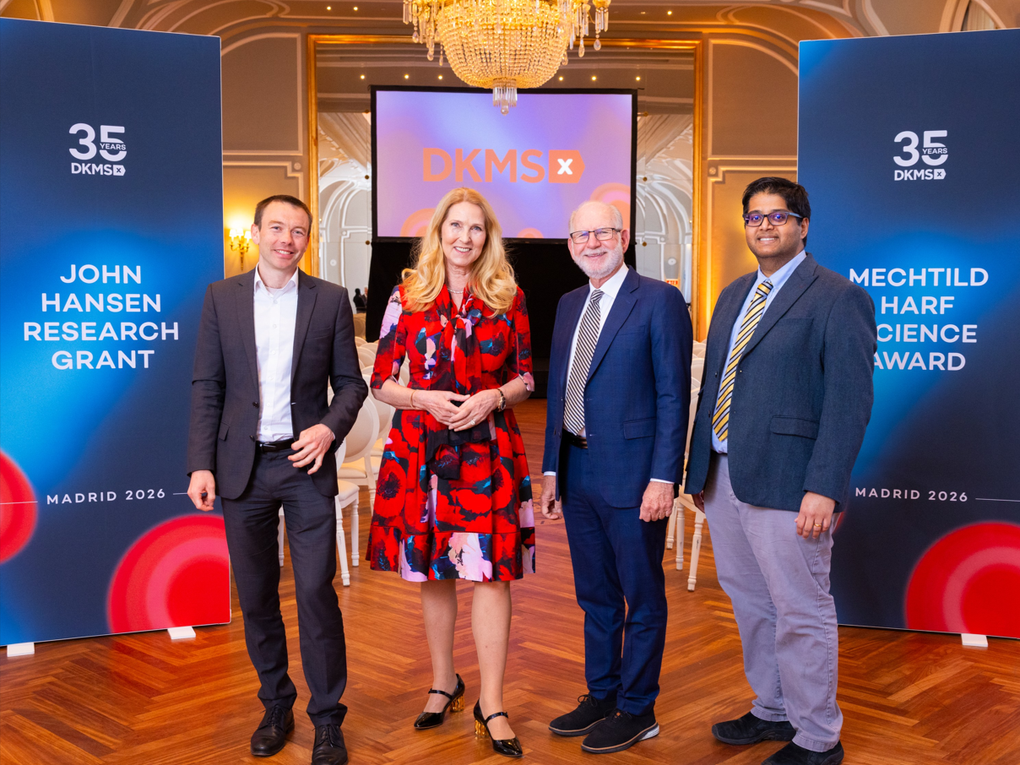
Honoring Scientific Excellence at the DKMS Awards Night
A Pioneer in Blood Cancer Research
We awarded the 2026 DKMS Mechtild Harf Science Award to one of the leading scientists in the field of transplant immunology: Robert Negrin, MD, Professor of Medicine at Stanford School of Medicine and current president of the American Society of Hematology (ASH).
Allogeneic hematopoietic stem cell transplantation (allo-HSCT) is currently one of the most effective treatments for hematological diseases such as leukemia. T cells of the immune system play a dual role in this process: They generate the life-saving graft-versus-leukemia (GvL) effect by specifically attacking cancer cells, but at the same time cause the potentially fatal graft-versus-host disease (GvHD). Negrin addressed the central question in his research: How can the GvL effect be maximized without risking GvHD?
He demonstrated that infusing regulatory and conventional T cells in a specific ratio and at a defined time point prevents GvHD, fights cancer, and ensures survival. [1] Twenty-five years later, this concept is now on the verge of clinical implementation for patients with blood cancer, with the aim of improving stem cell transplants and making them safer and better tolerated. [2,3] “When I saw the first results of our research, I was speechless. Today, I look back on my scientific life’s work and the many extraordinary people who have contributed with gratitude,” Negrin emphasized in his speech at the award ceremony. His commitment to young researchers is also a priority for him: “I’ve had the privilege of supporting talented people from all over the world in their scientific and medical training or as they launch their careers – and of learning just as much from them.”
“His groundbreaking research has significantly advanced the treatment of blood cancer and deepened our understanding of immune-mediated complications,” emphasized Prof. Marcel van den Brink, MD, PhD, Chair of our Medical Council.
Supporting the Next Generation of Researchers
Investing in early-career scientists remains a core part of our mission. This year, we awarded four early-career researchers with the DKMS John Hansen Research Grant 2026:
- Sandeep Raj, MD (Memorial Sloan Kettering Cancer Center, USA)
- Lars Velten, PhD (Centre for Genomic Regulation, Spain)
- Satoshi Kaito, MD, PhD (Memorial Sloan Kettering Cancer Center, USA)
- Zhenyu Dai, MD, PhD (Stanford School of Medicine, USA)
Each grant provides €240,000 over a period of three years to support innovative research projects in stem cell transplantation and cell therapy.
The promising research projects focus on new treatment options for blood cancer and disorders of the hematopoietic system, including new potential biomarkers for personalizing stem cell therapies for hemoglobinopathies, as well as new and innovative cell therapies for acute myeloid leukemia (AML). In addition, there are potential avenues for improving therapies using chimeric antigen receptor T cells (CAR-T cells), both through the further development of the CAR-T cell platform and its production, as well as through strategies to modulate the tumor immune microenvironment to enhance therapeutic efficacy.


Advancing Research Through Global Collaboration
For us, these awards are not only about recognition, they are about strengthening a global network dedicated to improving patient outcomes.
“Supporting the next generation of medical and scientific professionals is an investment in the future. Through our network, we facilitate vital personal exchanges,” emphasizes Prof. Dr. Johannes Schetelig, Director Clinical Research at DKMS and Head of the Department of Stem Cell Transplantation Unit at University Hospital Carl Gustav Carus in Dresden. “This award makes it clear that tomorrow’s blood cancer therapy requires excellent research, personal mentors, and international networking – key factors that have shaped DKMS for 35 years.”
As we mark 35 years of scientific commitment, the work honored in Madrid highlights the progress we have made in stem cell transplantation, and the innovations that will continue to transform the treatment of blood cancer and blood disorders worldwide.
References
- Edinger M. et al. Nat Med 2003 Sep;9(9):1144-50.doi: 10.1038/nm915. Epub 2003 Aug 17.
- Meyer E. et al. Blood 2025. doi: 10.1182/blood.2025031313. Online ahead of print.
- https://orcabio.com/orca-bio-announces-fda-acceptance-and-priority-review-of-the-biologics-license-application-bla-for-orca-t-to-treat-hematological-malignancies/