
In light of World Science Day: DKMS Research for Better Chances of Recovery
Many people know DKMS primarily as a stem cell donor registry. But its work doesn’t end once a compatible donor has been found. Even with a very good match in tissue characteristics, complications can arise after a stem cell transplant.
That is why DKMS is conducting research to further improve donor selection and make stem cell transplants even safer and more successful. This research spans a wide range of areas, from highly specialized laboratory diagnostics to clinical trials and international knowledge transfer.
The UNESCO World Science Day on November 10, 2026 has the theme “Common ground through science diplomacy.” The focus is on the idea that science can foster cooperation across borders and create shared knowledge, a concept that also shapes DKMS’s research work.
Beyond Registration: The Role of Research
The process begins with the registration of new donors. At the DKMS Life Science Lab, samples are typed, and HLA markers and other transplant-related markers are determined.
The best possible match between the patient’s and donor’s HLA characteristics is the first step, which is crucial for the outcome of a stem cell transplantation. However, other factors such as donor age, gender, or cytomegalievirus (CMV) status are also taken into account during the selection process. At the same time, DKMS examines additional immunogenetic characteristics that could enable an even more targeted donor selection. This means that the laboratory not only lays the foundation for the donor search; the insights gained there also enable us to continuously improve the selection of donors.
From the Search for Donors to Clinical Research
Even if one or more suitable donors are found for a patient, many medical questions remain: How do we make the best selection? How can we further improve the care surrounding transplantation? And how can complications be avoided as much as possible? The Clinical Trials Unit (CTU) of DKMS has been investigating these and other scientific questions since 2013.
DKMS conducts clinical trials in collaboration with hospitals, international registries, and study groups. These include, among others, the GRAPPA, ASAP, and HAMLET studies.
GRAPPA: New Findings on the Prevention of Graft-versus-Host Disease
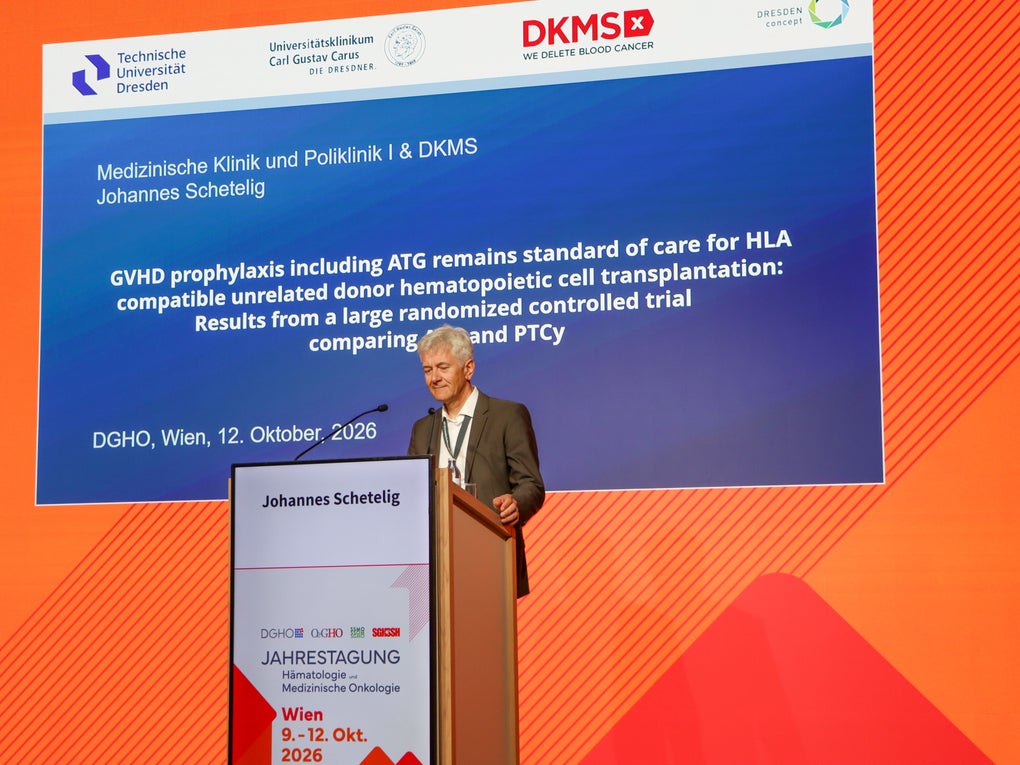
The GRAPPA trial compares two important pharmacological approaches to preventing graft-versus-host disease: PTCy (post-transplant cyclophosphamide) and ATLG (anti-T-lymphocyte globulin). Graft-versus-host disease is a rejection reaction in which immune cells from the transplant attack the patient’s tissue. For presenting the study results, Prof. Dr. Johannes Schetelig, was awarded the Best Abstract prize at the 2026 DGHO Annual Meeting in Vienna.
The results surprised both the study group and the scientific community: ATLG, a widely established standard in Europe, demonstrated superior outcomes compared with PTCy, an equally common approach, with a very low rate of treatment-related mortality without disease relapse and thus remains the standard for stem cell transplants from unrelated donors. [1] The findings also open up new scientific approaches, such as the combination of different procedures or tailored dosing strategies. The study, conducted at German transplant centers, thus also demonstrates how important collaborative clinical research is for the further development of transplant medicine.
Sharing Knowledge, Promoting Innovation
Many of these questions can hardly be answered by a single institution. Research in transplant medicine thrives on bringing together data, experience, and expertise to advance knowledge collectively. That is why DKMS networks with experts worldwide, strengthens existing partnerships, and establishes new collaborations.
This also includes promoting scientific exchange: For example with the DKMS John Hansen Research Grant, through which DKMS supports early-career researchers, the DKMS Impact Grant, a grant for research or sustainable projects to physician scientists from non-profit institutions (including public hospitals) in low- and middle-income countries and the DKMS Mechtild Harf Science Award, which recognizes outstanding scientific achievements in the field of stem cell transplantation.
A glance into the future
“Despite the remarkable progress we’ve already made, I believe we’re still only at the beginning of what’s possible. When I look 50 years ahead, I see a future in which stem cell transplantations will be much simpler and more patients can be cured,” says Prof. Dr. Johannes Schetelig.
Finding a suitable donor is a crucial first step. However, research, medical advances, and international collaboration are helping to continuously improve patients’ prospects even after a stem cell transplantation. Thus, DKMS’s research efforts are fully in line with the spirit of World Science Day: sharing knowledge, gaining new insights together, and helping to further improve treatment outcomes for patients.
References
- Stelljes, M. et. al. GVHD prophylaxis including ATG remains standard of care for HLA-compatible unrelated donor hematopoietic cell transplantation: Results from a large randomized controlled trial comparing ATG and PTCy. Presented at EHA 2026, Stockholm.